
Why your European sales cycle just doubled when you crossed Suvarnabhumi
A Field Guide to APAC B2B Patience
Somewhere over the Bay of Bengal, your forecast quietly broke.
You boarded in Frankfurt or Schiphol with a pipeline that made sense: a champion who loves your product, a budget holder who signs, a close date inside the quarter. You transit through Suvarnabhumi, you land in Taipei, Seoul, Tokyo or Bangkok — and within a month the deal that was "basically closed" has gone silent, and your European instincts are screaming at you to do something about it.
Here is the first thing I tell every European company I work with: the deal didn't slow down. It changed mechanism. And almost everything your instincts now tell you to do will make it worse.
I've been selling capital equipment in Asia since 2006; bakery and hatchery automation first, process and separation technology now, out of Taichung. I have lived inside this exact gap between European pipeline math and Asian reality for nearly twenty years. This is the field guide I wish someone had handed me on my first flight over.
Your European cycle ran on a champion. Your Asian cycle runs on consensus.
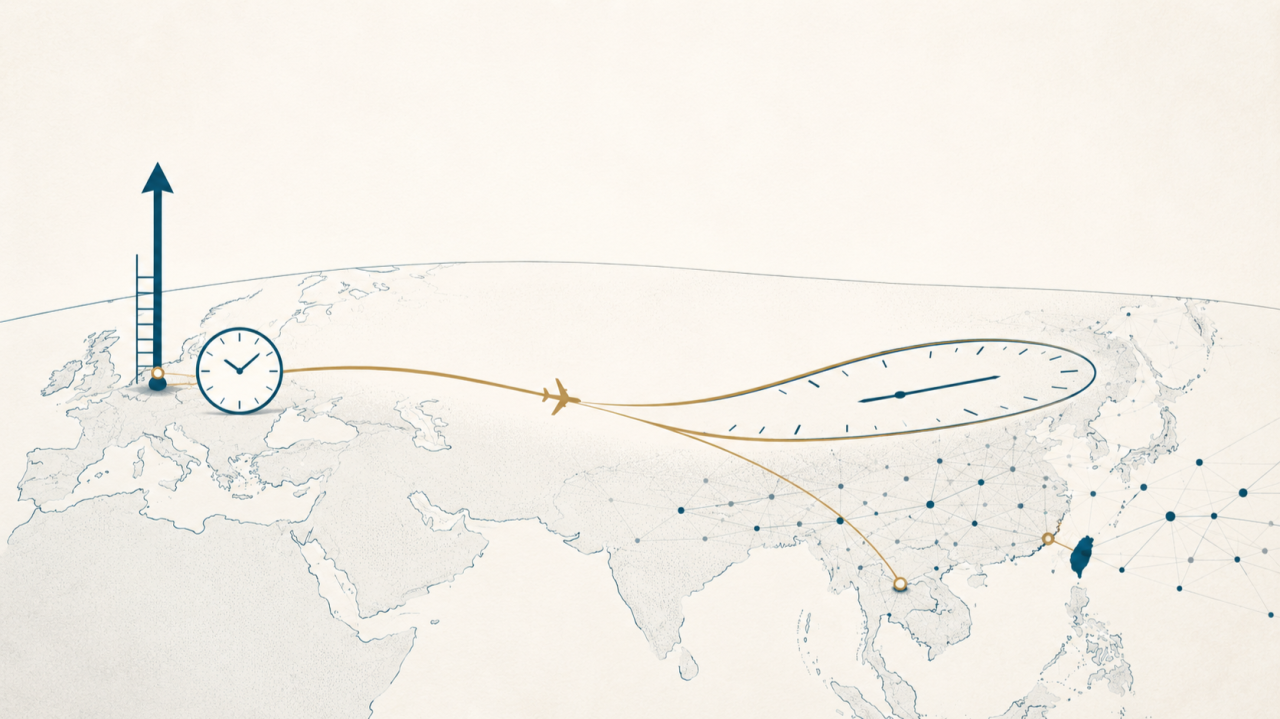
In most European B2B sales, you win by finding one person who wants you and one person who can pay, and getting them in a room. The cycle is essentially vertical: convince the champion, the champion convinces the boss, the boss releases budget. Two or three people, moving up a ladder.

In Taiwan, and in most of East Asia, the deal moves sideways before it ever moves up. Before anyone signs, a quiet web of people each has to become comfortable: the engineer who'll run your machine, his manager, the procurement team, the finance function, often a senior figure who never appears in a single meeting but whose nod everyone is privately waiting for. Nobody wants to be the single name attached to the risk of choosing a foreign supplier. So the organisation absorbs the decision collectively, at the speed of the slowest comfortable party.
That is why your cycle doubled. You are no longer persuading a champion. You are waiting for an entire system to exhale.
And here is the part that breaks European nerves: most of that process is invisible to you. The silence you're panicking about is not the deal dying. It is the deal working, internally, in rooms you're not in, in a language you may not read.
The relationship isn't the warm-up. It's the due diligence.
European sellers tend to treat relationship-building as the pleasant prelude to the real business. In Asia, it often is the real business. The dinners, the factory tours, the slow accumulation of small, low-stakes interactions, that is not you being entertained while the buyer makes up their mind elsewhere. That is the buyer making up their mind.

A Taiwanese manufacturer buying a six- or seven-figure machine is not buying a transaction. They are buying a fifteen- or twenty-year service relationship, and the thing they are really evaluating is whether you will still be there to answer the phone in year eight. They cannot find that in your spec sheet. So, they find it the only way trust is ever actually established: over time, through repeated contact, by watching how you behave when there's no order on the table.
Europeans read this as "slow." It is not slow. It is thorough. They are doing to you exactly what you should want a long-term partner to do.

A story from my own pipeline
Early in my time here I had a deal I was certain of. The demo had gone beautifully. The lead engineer was visibly excited. At the end he smiled, nodded, and said something that sounded, to my European ears, exactly like yes.
Then nothing. For months.
I did what every European does. I assumed I was being stalled. I started drafting the discount that would "create urgency." I considered going over the engineer's head to someone more senior who could "make a decision." I was, without realising it, about to detonate the deal.
What was actually happening was the opposite of stalling. The engineer's enthusiasm was real and he was spending those silent months doing the unglamorous internal work of getting his manager comfortable, getting procurement comfortable, and quietly checking, through his own network, whether our company was the kind that disappears when something breaks. The silence wasn't absence of progress. It was the progress.
The order came through. Not because I pushed, but because I didn't. Because I kept showing up, kept being useful, and let the system exhale at its own speed. The lesson cost me a lot of sleep to learn, and I have watched dozens of European firms refuse to learn it and lose deals they had already won.
The four European instincts that reset the clock to zero
When the silence stretches and the quarter-end pressure builds, European sellers reach for four moves. Every one of them is a reflex from a market that no longer applies, and every one of them sends the trust clock back to the start.
1. Discounting to force a close.
In Europe, a price drop signals flexibility. In Taiwan, an unprompted discount on a capital purchase often signals the opposite; that your original price wasn't honest, or that you're desperate, or that the quality isn't what you claimed. You think you're greasing the deal. You're introducing doubt.
2. Going over someone's head.
Escalating to a more senior contact to "get a decision" reads as bypassing the very person who was building your consensus for you internally. You haven't accelerated anything. You've embarrassed your own champion and exposed yourself as someone who doesn't understand how the room works.
3. Going quiet yourself, out of frustration.
This is the quiet killer. The European decides the deal is dead, stops investing, and pulls back: at precisely the moment the buyer was watching to see whether you'd still be around. You confirmed their deepest worry: that you disappear when there's no immediate order. Clock to zero.
4. Demanding a timeline.
"When can you make a decision?" feels like reasonable professionalism in Europe. In a consensus culture it asks someone to commit publicly to something the group hasn't finished deciding, which is exactly the exposure the whole structure exists to avoid. You will get a polite non-answer, and you'll have taught them to manage you with politeness.

So what does patience actually look like in practice?
Patience here is not passivity. That's the misread. Doing nothing while you wait is just as fatal as pushing; it confirms you only show up when there's money on the table.
Active patience looks like this: you keep showing up with something useful and nothing to sell. A relevant case from another plant. A technical answer to a problem that isn't even yours. A visit with no agenda. You stay present without applying pressure. You let the buyer set the tempo while you quietly remove every reason for them to doubt your longevity. You build, in plain sight, the evidence that the answer to "will you still be here?" is yes.
That is the whole game. And it is a game a desk in Europe cannot play, because it runs on presence.
The decision to make this quarter
Stop forecasting your APAC pipeline on European timelines. This quarter, take every open Asian opportunity in your CRM and do two things:
First, re-baseline the close dates. If your European cycle for this kind of deal is, say, six months, assume your Taiwan equivalent is twelve to eighteen, and rebuild your forecast (and your board's expectations) around that honest number. Half the "failures" I'm called in to diagnose are not lost deals. They're deals being forecast on the wrong clock, written off three months before they were ever going to close.
Second, pick one stalled-looking deal and make a commitment in writing to your own team: for the next ninety days, you will not discount it, you will not escalate over your contact, and you will not go quiet. You will only stay useful and present. Then watch what the silence was actually doing.
If your whole APAC forecast is built on European pipeline assumptions (and the pressure from headquarters is to "just close it") that's a conversation worth having before the next board meeting, not after it.
Book a 30-minute Taiwan-readiness call and bring your most frustrating stalled deal. Nine times out of ten, it isn't stalled. It's just on Taiwan time.
This article is general guidance drawn from operating experience, not a substitute for advice on your specific accounts. Markets, sectors, and individual buyers vary — talk to us about yours.
