
The four-gate decision that decides 80% of Taiwan entries
Subsidiary, branch or representative office in Taiwan? Most European companies pick the wrong one for the wrong reason. Here are the four gates that decide it, and that, from someone who has sold capital equipment here since 2006.
Most of the European companies I meet treat the legal-entity question as paperwork. Something to hand to a lawyer or an accounting firm once the "real" strategy is done. They are wrong, and it costs them a year.
I have watched this pattern repeat for the better part of two decades. The structure you register in Taiwan is not an administrative footnote that follows your go-to-market plan; it is the first half of your go-to-market plan. It decides whether you can invoice your first customer, how exposed your parent company is when a contract sours, how much of your profit survives the trip back to Rotterdam or Düsseldorf, and (the part nobody puts in the brochure) what your future Taiwanese customers and hires silently conclude about how serious you are.
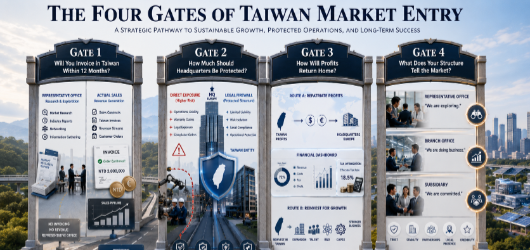
There are only three structures to choose from. But there are four gates you have to walk through to choose correctly. Get the gates in the wrong order and you will pick the right-sounding structure for entirely the wrong reason.
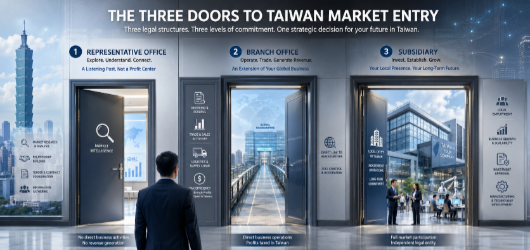
First, the three doors (quickly)
I will keep this part short, because this is the part every other firm leads with and it is the least interesting.
Representative office.
The cheapest and fastest to stand up. Under Article 386 of Taiwan's Company Act, it lets a foreign company "file for the record" with the Ministry of Economic Affairs to perform a narrow set of legal actions; quoting, negotiating, signing, bidding for tenders, procurement, and market research. What it explicitly cannot do is conduct business, issue invoices, or generate revenue. It is a listening post with a stamp.
Branch office.
A direct extension of your parent company. It can trade, invoice, and book revenue locally. But it carries no separate legal personality; your headquarters is jointly liable for what the branch does. Its quiet advantage is tax: profits remitted from a Taiwan branch back to the parent are treated as intra-company transfers and are not hit by the withholding tax that applies to dividends paid out by a subsidiary.
Subsidiary.
Usually, a company limited by shares. A full Taiwanese legal person, liability ring-fenced from the parent, able to do everything a local company can do. It is the most common choice for anyone planning to actually build something here, and the most involved to establish, because it requires Foreign Investment Approval from the MOEA's investment-review function before you can register at all. (If any of your capital traces back to a mainland Chinese investor, expect that review to be slower and more searching; plan for it now, not in month four.
That is the menu. Now the part that matters.
The four gates
Gate 1: Will you invoice and collect money in Taiwan within 12 months?
This is the gate that quietly kills the most entries, and it kills them with the most popular option.
The representative office is seductive. It is cheap, it is fast, and "let's just open a rep office to test the market" sounds like prudent, low-risk discipline to a board in Europe. The problem is that the moment a real customer says yes, you discover your rep office is legally forbidden from sending them an invoice. Your hard-won first order has to be routed back through your European entity, with the lead times, currency friction, and "why are we buying from Europe again?" questions that kill momentum at exactly the moment you needed it.
So, the first gate is brutally simple. Write down your honest forecast for invoiced revenue inside Taiwan in the first twelve months. If that number is anything above zero, the representative office is already the wrong answer, no matter how much cheaper it looks. A rep office is only correct when you genuinely have nothing to sell yet: pure scouting, sourcing, or pre-launch relationship-building with a hard "no transactions" rule.
Gate 2: How much does your parent company need to be ring-fenced?
If you have cleared Gate 1, you are choosing between a branch and a subsidiary, and the next question is about risk, not tax.
A branch is your parent company wearing a Taiwanese name tag. If a Taiwan contract goes badly (a disputed delivery, a warranty fight, a local employment claim) the liability does not stop at the Taiwan Strait. It lands on the headquarters balance sheet. For a small accessory product that is often an acceptable risk. For capital equipment, long commissioning periods, on-site safety exposure, or anything regulated, it frequently is not.
A subsidiary draws a legal line. The parent's exposure is, in normal circumstances, limited to the capital it put in. When I am sitting with an industrial client whose machines are large, expensive, and installed inside someone else's factory, this gate alone usually settles the question.
Gate 3: How will profit get home, and what leaks on the way?
Now, and only now, bring in tax.
I put this third on purpose. I have seen finance directors lead with the withholding-tax advantage of a branch and back into a structure that leaves their €40m parent company jointly liable for a Taiwanese welding accident; to save a few points on profit repatriation they may not even make for three years. That is the analyst's chair talking, not the operator's.
But once liability is settled, the tax difference is real money. Branch profits flow back to the parent as internal transfers, untouched by the dividend withholding that a subsidiary's distributions attract. If your model shows meaningful profit being pulled out of Taiwan early and often, that gap compounds. If your model shows profit being reinvested locally to fund growth (which is what most genuine market builders actually do) the gap shrinks and Gate 2 should win.
Gate 4: What does this structure tell the market about you?
Here is the gate the lawyers and the compliance-led firms never write about, because it does not live in the Company Act. It lives in the room.
In Taiwan, the entity you register is read as a statement of intent. A representative office tells a prospective distributor, "we are looking around." A branch says, "we are doing business here." A subsidiary says, "we are committing to this market, with our own balance sheet and our own people." Taiwanese buyers of industrial and process technology are buying a twenty-year service relationship, not a transaction, and they notice which of those three sentences you are saying. So do the senior local engineers and salespeople you will eventually want to hire, who will not leave a stable Taiwanese employer for a foreign "rep office" that might fold the moment Europe gets nervous.
This is the gate I care about most, because it is the one a desk-bound advisor cannot feel. The cheapest structure on the spreadsheet is sometimes the most expensive structure in the room.